Friday, July 27, 2007
Harry Potter
Embarrassingly, I haven't been to a casino since Harry Potter came out. Poker players are not particularly likely to read it, but they are likely to think it's funny to spoil the ending. I'm gonna have to finish it today so I can get back to work.

Friday, July 13, 2007
"Look Down Here"
I was playing the $500 NL game at Hollywood Park when a semi-regular player took the seat to my right. About seventy-five years old and five foot one inch tall, he's a cantankerous eastern European who has caused a few heated disputes in my previous sessions at his table. As is the case with a surprising number of poker players, his deficiencies in English don't dissuade him at all from taunting and complaining about the other players.
Anyway, this ornery old man sat down next to me with a stack of mostly $1 and $5 chips. To me it looked like he might have had less than $500 there. I wouldn't really care except that the rules require players to buy-in for at least $500 in this game, and I didn't want there to be an issue later on. His left arm was blocking my view of his stack, so I asked him, "do you have 500 there?"
He looked at me rather disgustedly but said nothing. "How many chips have you got there?" I asked. Pushing back in his chair, he turned to me and yelled"Count!" pointing at his chips. I counted them and there was exactly $500 in chips. "Looks like 500," I said.
"Look down here," he snarled at me. At his waist, out of sight of the dealer, he was giving me the finger. I laughed and just said, "Okay, thanks. That's wonderful." About an hour later he was kicked off the table after a confrontation with another player.
Anyway, this ornery old man sat down next to me with a stack of mostly $1 and $5 chips. To me it looked like he might have had less than $500 there. I wouldn't really care except that the rules require players to buy-in for at least $500 in this game, and I didn't want there to be an issue later on. His left arm was blocking my view of his stack, so I asked him, "do you have 500 there?"
He looked at me rather disgustedly but said nothing. "How many chips have you got there?" I asked. Pushing back in his chair, he turned to me and yelled"Count!" pointing at his chips. I counted them and there was exactly $500 in chips. "Looks like 500," I said.
"Look down here," he snarled at me. At his waist, out of sight of the dealer, he was giving me the finger. I laughed and just said, "Okay, thanks. That's wonderful." About an hour later he was kicked off the table after a confrontation with another player.
Tuesday, July 03, 2007
The Psychology of Poker
Despite assuming a knowledge of basic poker strategy, Alan N. Schoonmaker's book The Psychology of Poker is based on the odd premise that the reader is not a good player. More specifically, it assumes that while the reader may be able to make himself into a decent player, he will never be able to develop the instincts or intuitions of the top pros. Dr. Schoonmaker feels that this has created a disconnect between the advice given in the existing poker literature and the advice that would actually help the readers. He provides a few examples of advice that is rather useless because of this problem, including the part in Doyle Brunson's Super/System where he explains that you should "stick to your first impression" because "... I get a feeling that he's bluffing or that I can make a play here and get the pot. But, actually my subconscious mind is reasoning it all out." While I'm not as pessimistic as Schoonmaker in assuming that such abilities cannot be developed, I will concede that having such "advice" in a book is not likely to help anyone improve.
The reason Schoonmaker begins his book with this analysis of existing poker literature is to explain the ommission of the aspect of poker psychology that the book does NOT address. Unfortunately, this omission constitutes what is by far the most interesting aspect of the psychology of poker. The ability to divine an opponent's thoughts and motivations in order to read his cards is precisely what is meant when people refer to poker psychology. In light of that, I suppose it was necessary for Schoonmaker to provide his disclaimer at the start of the book. However, it would have been appreciated if he went one step further and changed the book's title to something less misleading. Something like "Becoming an Introspective Poker Player and Sizing up Your Competition," would be more appropriate. Of course, not many people would bother buying that book, though.
Having confessed the true intent of The Psychology of Poker, Schoonmaker describes the actual focus of his book: helping the reader to improve his style, choose appropriate games, and adjust to different players and games. Schoonmaker's main goal is to encourage his readers to honestly evaluate their own motivations in playing poker and to help them identify what exactly is holding them back from becoming better players. In most cases, what holds players back is simply a failure to concentrate and apply the basic strategic rules that most players already know. In encouraging his readers to be brutally honest with themselves about their motivations at the poker table, Schoonmaker exposes some discomforting (but potentially remediable) truths about what attracts us to poker. For example he asks his readers to put numbers indicating what motivates them to play poker. The numbers should add up to 100%. The options are:
Make money;
Socialize, meet people;
Relax;
Get excitement of risk;
Test self against competitive challenges;
Sense of accomplishment from winning;
Pass time;
Other (specify).
Filling out this chart made it uncomfortably obvious that I have sacrificed at least some amount of earning potential for the sake of socializing, relaxing, and testing myself against competitive challenges. For example, I am compromising my win rate whenever I discuss strategy with an opponent (which I do rarely), relax instead of concentrate on my opponents, or play in a game without bothering to ensure that there are no softer games available. In other words, the book has forced me to admit that in order to make poker rather enjoyable, I routinely engage in behaviors that are deleterious to my bottom line. Does this mean I should strive to eliminate all these "leaks"? Probably not, but if I want to be honest with myself I should at least acknowledge that I'm sacrificing some earning potential for some enjoyment.
The bulk of the book is actually about how to play against certain styles of players on the two main spectra: loose-tight and passive-aggressive. Also, it strongly encourages the reader to focus on being a tight-aggressive player himself. This information is accurate, but for someone who has already read a lot of poker books and articles, there's not much new here.
The reason Schoonmaker begins his book with this analysis of existing poker literature is to explain the ommission of the aspect of poker psychology that the book does NOT address. Unfortunately, this omission constitutes what is by far the most interesting aspect of the psychology of poker. The ability to divine an opponent's thoughts and motivations in order to read his cards is precisely what is meant when people refer to poker psychology. In light of that, I suppose it was necessary for Schoonmaker to provide his disclaimer at the start of the book. However, it would have been appreciated if he went one step further and changed the book's title to something less misleading. Something like "Becoming an Introspective Poker Player and Sizing up Your Competition," would be more appropriate. Of course, not many people would bother buying that book, though.
Having confessed the true intent of The Psychology of Poker, Schoonmaker describes the actual focus of his book: helping the reader to improve his style, choose appropriate games, and adjust to different players and games. Schoonmaker's main goal is to encourage his readers to honestly evaluate their own motivations in playing poker and to help them identify what exactly is holding them back from becoming better players. In most cases, what holds players back is simply a failure to concentrate and apply the basic strategic rules that most players already know. In encouraging his readers to be brutally honest with themselves about their motivations at the poker table, Schoonmaker exposes some discomforting (but potentially remediable) truths about what attracts us to poker. For example he asks his readers to put numbers indicating what motivates them to play poker. The numbers should add up to 100%. The options are:
Make money;
Socialize, meet people;
Relax;
Get excitement of risk;
Test self against competitive challenges;
Sense of accomplishment from winning;
Pass time;
Other (specify).
Filling out this chart made it uncomfortably obvious that I have sacrificed at least some amount of earning potential for the sake of socializing, relaxing, and testing myself against competitive challenges. For example, I am compromising my win rate whenever I discuss strategy with an opponent (which I do rarely), relax instead of concentrate on my opponents, or play in a game without bothering to ensure that there are no softer games available. In other words, the book has forced me to admit that in order to make poker rather enjoyable, I routinely engage in behaviors that are deleterious to my bottom line. Does this mean I should strive to eliminate all these "leaks"? Probably not, but if I want to be honest with myself I should at least acknowledge that I'm sacrificing some earning potential for some enjoyment.
The bulk of the book is actually about how to play against certain styles of players on the two main spectra: loose-tight and passive-aggressive. Also, it strongly encourages the reader to focus on being a tight-aggressive player himself. This information is accurate, but for someone who has already read a lot of poker books and articles, there's not much new here.
Tuesday, June 26, 2007
Poker Honesty Breaking Down
Somehow, the increase in the number of players in casinos who take poker strategy seriously has coincided with a decrease in observance of poker rules and etiquette. In some sense, I suppose this is to be expected - more experienced players are more aware of what rules can be bent without causing complaint. Still, I had imagined that more serious players would be more inclined to promote a culture of playing by the rules. After all, if you have a deep understanding of poker strategy, encouraging fair play would seem to be in your best interest. A couple years ago, I think this theory prevailed, and the regular players would often complain if, for example, an inexperienced player tried giving advice to someone in a hand. Also, experienced players who bent the rules would do so surreptitiously or risk being called out by other players.
Yesterday, just after I sat down to play the 5-10NL game at Hollywood Park, a guy in a suit with whom I had played once or twice before walked over to the table. When he saw me there he smiled broadly and said "Hi!" While I welcome friendly greetings, this was a bit odd because I don't personally remember ever actually talking to him before, and there were several other regular players at the table who he'd surely also seen before. Staring at him for a second and failing to remember why he might be specifically excited to see me, I said "...hi." Thinking the interaction was over, I went back to playing.
A few minutes later the suited guy who had said "hi" to me joined the game and took the seat to my right. He was very interested in the tennis on the TV - evidentally Tim Henman often loses in the semifinals and was on the verge of doing so again. I know only a little about pro tennis, but I engaged him in light conversation. Soon we played the following hand: In early middle position, he raised to $45. I called with AQd, and everyone else folded. I had his $450 stack covered. The flop came Q96 with one diamond. He checked and I bet $60 into the $100 pot. He raised to $120. Obviously this is a bit fishy, but my hand seemed too strong to fold being given 4.7-1 odds. Besides, I had position and maybe I could get a backdoor flush draw and win a big pot. The turn was the Kd. I picked up a flush draw, but I no longer had top pair. My new friend bet $200, leaving him with only about $90 left. As I was trying to figure out what my odds were against different likely hands of his, I heard him mutter something to me out of the side of his mouth.
"What's that?" I asked him.
"Set of nines," he whispered to me again.
In light of the fact that this guy had shown a strong desire to be my friend, I folded a couple seconds later. He flashed his pocket 9's to me (and only me) as he threw his cards back to the dealer. This is a strangely common practice - making a bet with a big hand and then taking pity on your opponent and telling them what you have. Occasionally, a player will even show his big hand to his opponent. Two thing that made this particular instance notable:
1. Such pity is rarely directed towards ME.
2. Usually the player speaks loudly enough for the whole table to hear.
Later, in the middle of a hand he was already out of, my shifty new friend whispered advice to me during hands I was involved in: for instance, "that guy always plays weak aces," or "don't believe what he's saying." At one point he actually kicked me under the table before raising - something people joke about sometimes because it is so clearly unscrupulous (the idea being that we may have agreed that this signals he has a big hand or something - of course, we hadn't actually made such an agreement, and since I acted after his raise, the kicking of me was rather pointless). Perhaps needless to say, he offered to check down any hands where we found ourselves heads-up. I declined in all but one instance.
The striking thing to me about this story is not the bizarrely ingratiating behavior on the suited guy's part, but his implicit assumption that I would be appreciative and complicit in his cheating. I think it says a lot about the current culture in poker rooms - whereas before I think I could assume people would generally play by the rules, I now think I need to assume that my opponents will try to cheat me if they are confident they will get away with it. Then again, I've started to suspect this is the case in my daily life outside of poker as well. So I guess either dishonesty has become a larger cultural trend or I am just starting to become less naive. Also worth considering is the possibility that I'm descending into some sort of psychotic paranoia.
Yesterday, just after I sat down to play the 5-10NL game at Hollywood Park, a guy in a suit with whom I had played once or twice before walked over to the table. When he saw me there he smiled broadly and said "Hi!" While I welcome friendly greetings, this was a bit odd because I don't personally remember ever actually talking to him before, and there were several other regular players at the table who he'd surely also seen before. Staring at him for a second and failing to remember why he might be specifically excited to see me, I said "...hi." Thinking the interaction was over, I went back to playing.
A few minutes later the suited guy who had said "hi" to me joined the game and took the seat to my right. He was very interested in the tennis on the TV - evidentally Tim Henman often loses in the semifinals and was on the verge of doing so again. I know only a little about pro tennis, but I engaged him in light conversation. Soon we played the following hand: In early middle position, he raised to $45. I called with AQd, and everyone else folded. I had his $450 stack covered. The flop came Q96 with one diamond. He checked and I bet $60 into the $100 pot. He raised to $120. Obviously this is a bit fishy, but my hand seemed too strong to fold being given 4.7-1 odds. Besides, I had position and maybe I could get a backdoor flush draw and win a big pot. The turn was the Kd. I picked up a flush draw, but I no longer had top pair. My new friend bet $200, leaving him with only about $90 left. As I was trying to figure out what my odds were against different likely hands of his, I heard him mutter something to me out of the side of his mouth.
"What's that?" I asked him.
"Set of nines," he whispered to me again.
In light of the fact that this guy had shown a strong desire to be my friend, I folded a couple seconds later. He flashed his pocket 9's to me (and only me) as he threw his cards back to the dealer. This is a strangely common practice - making a bet with a big hand and then taking pity on your opponent and telling them what you have. Occasionally, a player will even show his big hand to his opponent. Two thing that made this particular instance notable:
1. Such pity is rarely directed towards ME.
2. Usually the player speaks loudly enough for the whole table to hear.
Later, in the middle of a hand he was already out of, my shifty new friend whispered advice to me during hands I was involved in: for instance, "that guy always plays weak aces," or "don't believe what he's saying." At one point he actually kicked me under the table before raising - something people joke about sometimes because it is so clearly unscrupulous (the idea being that we may have agreed that this signals he has a big hand or something - of course, we hadn't actually made such an agreement, and since I acted after his raise, the kicking of me was rather pointless). Perhaps needless to say, he offered to check down any hands where we found ourselves heads-up. I declined in all but one instance.
The striking thing to me about this story is not the bizarrely ingratiating behavior on the suited guy's part, but his implicit assumption that I would be appreciative and complicit in his cheating. I think it says a lot about the current culture in poker rooms - whereas before I think I could assume people would generally play by the rules, I now think I need to assume that my opponents will try to cheat me if they are confident they will get away with it. Then again, I've started to suspect this is the case in my daily life outside of poker as well. So I guess either dishonesty has become a larger cultural trend or I am just starting to become less naive. Also worth considering is the possibility that I'm descending into some sort of psychotic paranoia.
Monday, June 18, 2007
Vegas Weekend
I took a quick trip to Vegas last weekend, but not quite long enough to actually enter any of the WSOP events. I drove there and back with Aaron, who couldn't get a whole lot of time off of work. Once again, I somehow managed to be surprised by how much better it is to play poker in Vegas. How is this even a contentious issue? From what I've seen, Las Vegas poker is unquestionably superior, but it seems that half of the articles I've read on the subject say that LA poker is just as good or better than Vegas. This is in line with anecdotal evidence I've gathered from other players. I just don't get it. Where are these people playing in LA? Every casino here in LA has a higher rake and also take $1 out for the frivolous "jackpots" that ruins the game whenever two aces flop (on the plus side, I suppose it attracts some simple-minded players who would not otherwise play). Moreover, the casinos are simply not as nice in LA, and the competition has been significantly tougher in my experience. Perhaps most significant is the fact that alcoholic drinks are free in Vegas, but not in LA. Aaron, Joe, and I took advantage of this Saturday night at the palms. I also did well playing the Mirage's SNG tournaments.
I think I'll take another trip to Vegas this month and try to play in one of the WSOP tournaments, against some advice I've read. I'm not sure yet if I'll stay with a friend or stay in a hotel for a few days. I probably still have a lot of comp points at a few of the casinos there.
I think I'll take another trip to Vegas this month and try to play in one of the WSOP tournaments, against some advice I've read. I'm not sure yet if I'll stay with a friend or stay in a hotel for a few days. I probably still have a lot of comp points at a few of the casinos there.
Thursday, May 31, 2007
End of Slump?
After a very successful April, I'm going to have my first losing month in almost a year unless I have a truly remarkable win today. I had modest wins my last two trips, so hopefully I've broken out of the losing streak. Actually, the only respite from my losing streak has been the wins I've had recently in the HORSE game I mentioned last time - we've now had two sessions. I invited Aaron the second time, and we both won over $300 playing 3-6 limit for maybe four hours; this is a truly remarkable feat when you consider that our opponents ranged from very good to outstanding poker players. I think Razz is my new favorite game - in any case, it's the one I've gotten luckiest at.
I still haven't gotten around to reviewing No Limit Hold'em by Sklansky and Miller, and I've read most of it twice now, and I've also read The Psychology of Poker and am a quarter of the way through The Mathematics of Poker. A brief summary of my impressions: No Limit Hold'em is probably the most worthwhile book on the subject that I've come across. The first part is a useful discussion of "fundamentals," none of which is new to me, but most of which is worth thinking about again. The last part is a list of 50 "concepts" that I am considering sifting through for discussion in future posts. The Psychology of Poker has some unique material, but, disappointingly, it's targeted towards novice players. Still , there are some worthwhile points to consider like the motivations people have for playing and how to notice them. It also encourages the reader to evaluate his own motives, which may be illuminating. The Mathematics of Poker is a relatively technical discussion of game theory with the goal of training the reader's intuition in order to make better decisions at the poker table. I'm excited to read more of this - having a solid base of poker knowledge that can be proven theoretically is a great boost to confidence. Being in the midst of a losing streak, I'm relieved to be restoring my confidence by developing some solid groundwork in game theory.
I still haven't gotten around to reviewing No Limit Hold'em by Sklansky and Miller, and I've read most of it twice now, and I've also read The Psychology of Poker and am a quarter of the way through The Mathematics of Poker. A brief summary of my impressions: No Limit Hold'em is probably the most worthwhile book on the subject that I've come across. The first part is a useful discussion of "fundamentals," none of which is new to me, but most of which is worth thinking about again. The last part is a list of 50 "concepts" that I am considering sifting through for discussion in future posts. The Psychology of Poker has some unique material, but, disappointingly, it's targeted towards novice players. Still , there are some worthwhile points to consider like the motivations people have for playing and how to notice them. It also encourages the reader to evaluate his own motives, which may be illuminating. The Mathematics of Poker is a relatively technical discussion of game theory with the goal of training the reader's intuition in order to make better decisions at the poker table. I'm excited to read more of this - having a solid base of poker knowledge that can be proven theoretically is a great boost to confidence. Being in the midst of a losing streak, I'm relieved to be restoring my confidence by developing some solid groundwork in game theory.
Friday, May 18, 2007
HORSE Home Game
At Hollywood Park a couple weeks ago, I struck up a conversation with one of Brigid's professors. I recognized him as the one who organized the Tom Ferguson Tournament. In the ensuing email exchange, he invited me to join an online poker discussion group he's in. My impression is that most of the other members (there are over twenty, I think, but most hardly ever post) are not pros, but the guy who runs it is. The other players seem knowledgeable and thoughtful, too. It seems several of them know each other through the chess circuit, and there's at least one professional chess player. My impression is that it is a pretty impressive and worthwhile group. Anyway, while scanning the archives, I saw that they had tried to start up a HORSE game back in March but couldn't get enough people interested. I thought HORSE sounded like a good idea, so I commented that I'd be interested in playing; on Monday, about ten of us went to Brigid's professor's house to play 3-6 limit HORSE (limit Holdem, Omaha hi-low, Razz, Seven card stud, and stud hi-low Eight or better).
The group was split into two games. I think the other table was playing .50-1 HORSE. At my table was Brigid, two pros (including Danyul, who runs the group and has a poker blog of his own), and two other players who I don't think were pros but were also good players. Later on one of them left and Brigid's professor joined us.
Some of these games I hadn't played since that mixed game at the Wynn a year and a half ago. In that game we had played deuce to seven triple draw instead of stud, but other than that it was the same. Other than calling with a Q-high low hand in Stud Eight or Better, I think I did reasonably well. In case you're unfamiliar with Stud Eight or Better, half the pot goes to the low hand, but only if there is five card low to an 8. So my Q-high wasn't even eligible for the low there. My excuse is that I used to play this same game a lot in high school, except that there was no restriction on how low the low hand had to be. Also, in the version we played in high school we had to declare if we were going for the high, low, or both, and then we bet for a sixth time. A better game in my opinion, although a bit gimmicky. Actually, I like all those crazy games like Baseball and Follow the Queen. They make you think on your feet strategically because nobody ever bothers to actually analyze those games. It makes for a fun battle of wits.
The other pro at my table was a Swedish guy who is working on poker game theory with Tom Ferguson at UCLA. It turns out he was almost certainly the most accomplished player at the table. In Sweden, he tells me, the tax code requires that they report their winnings on every pot that they win! I keep track of my day-to-day net winnings, but on any given day I play hundreds, maybe thousands of hands. I can't imagine how tedious it might be to actually keep track of such a thing. I guess if you play online though you can have a program to track it automatically for you.
The game was considered a great success, and there's talk of organizing for another session, possibly even on a weekly basis. I'm going to argue for some 2-7 triple draw.
The group was split into two games. I think the other table was playing .50-1 HORSE. At my table was Brigid, two pros (including Danyul, who runs the group and has a poker blog of his own), and two other players who I don't think were pros but were also good players. Later on one of them left and Brigid's professor joined us.
Some of these games I hadn't played since that mixed game at the Wynn a year and a half ago. In that game we had played deuce to seven triple draw instead of stud, but other than that it was the same. Other than calling with a Q-high low hand in Stud Eight or Better, I think I did reasonably well. In case you're unfamiliar with Stud Eight or Better, half the pot goes to the low hand, but only if there is five card low to an 8. So my Q-high wasn't even eligible for the low there. My excuse is that I used to play this same game a lot in high school, except that there was no restriction on how low the low hand had to be. Also, in the version we played in high school we had to declare if we were going for the high, low, or both, and then we bet for a sixth time. A better game in my opinion, although a bit gimmicky. Actually, I like all those crazy games like Baseball and Follow the Queen. They make you think on your feet strategically because nobody ever bothers to actually analyze those games. It makes for a fun battle of wits.
The other pro at my table was a Swedish guy who is working on poker game theory with Tom Ferguson at UCLA. It turns out he was almost certainly the most accomplished player at the table. In Sweden, he tells me, the tax code requires that they report their winnings on every pot that they win! I keep track of my day-to-day net winnings, but on any given day I play hundreds, maybe thousands of hands. I can't imagine how tedious it might be to actually keep track of such a thing. I guess if you play online though you can have a program to track it automatically for you.
The game was considered a great success, and there's talk of organizing for another session, possibly even on a weekly basis. I'm going to argue for some 2-7 triple draw.
Wednesday, May 09, 2007
Semi-Aborted Bluff Pays Off
Often I find myself in a "weak-tight" type game at Hollywood Park that I can exploit by playing a bit loose pre-flop and then attacking weakness on the flop and turn. I was in such a game yesterday. There was one player that didn't fit the mold of "weak-tight," but as it happened, he was the easiest to extract chips from anyway. He's a regular player, an Israeli guy about 50 years old. Often he plays quite well but he is very quick to go on tilt and start playing very, very loose. He was in such a phase yesterday for most of the day, and often he was the only one calling my semi-bluff pre-flop raises of $35-60. When this was the case, I would invariably bet the flop. Every time but once he folded at this point (the other time he raised me all-in and I folded). This strategy was working so well for me that I expanded my semi-bluffing range to the extent that any observant player would become very suspicious of me.
I won one such hand in a very unorthodox manner. Pre-flop, someone had limped in early position, and I raised to $50 with 75s from middle position. A middle-aged Asian guy who I had played with quite a bit called me from the button. Everyone else folded.
With the pot at $120, the flop came something like AhQs7d. Having called my raise preflop, my opponent likely had a small pair, but there were plenty of other possibilities. I completely missed the flop, but I thought there was a good enough chance he'd fold that I decided to bet $80. In order to save time, this guy had the fairly common habit of folding his hand as soon as it became apparent that his heads-up opponent planned to bet. As I brought the chips out and started to cut it into four stacks of $20, I noticed that my opponent was just watching me. More significantly, he was not immediately folding his cards. In the absence of a premature fold on his part, the likelihood that he would fold to my bluff decreased; he was probably planning to call or raise. I decided in that split second that I would cut my losses. I had already laid out two $20 stacks, but I brought back the other $40 I had planned to bet.
This very small bet seemed to throw my opponent off. He decided to fold, presumably thinking I was trying to suck him in with a big hand like a set of Aces or Queens. This line of thinking seems rather pervasive: large bets mean bluffs, small bets mean big hands. I've been taking advantage of this realization for quite a while by blatantly betting big with good hands and small when I'm bluffing. People don't pick up on the pattern nearly as easily as you might think. In any case, the hand I just described made me realize I can probably go to even greater lengths to exploit this backward idea of respecting small bets more than larger ones. At least against certain players, it seems I can bet nearly nothing on my bluffs and I think I might get them to fold just as often.
I won one such hand in a very unorthodox manner. Pre-flop, someone had limped in early position, and I raised to $50 with 75s from middle position. A middle-aged Asian guy who I had played with quite a bit called me from the button. Everyone else folded.
With the pot at $120, the flop came something like AhQs7d. Having called my raise preflop, my opponent likely had a small pair, but there were plenty of other possibilities. I completely missed the flop, but I thought there was a good enough chance he'd fold that I decided to bet $80. In order to save time, this guy had the fairly common habit of folding his hand as soon as it became apparent that his heads-up opponent planned to bet. As I brought the chips out and started to cut it into four stacks of $20, I noticed that my opponent was just watching me. More significantly, he was not immediately folding his cards. In the absence of a premature fold on his part, the likelihood that he would fold to my bluff decreased; he was probably planning to call or raise. I decided in that split second that I would cut my losses. I had already laid out two $20 stacks, but I brought back the other $40 I had planned to bet.
This very small bet seemed to throw my opponent off. He decided to fold, presumably thinking I was trying to suck him in with a big hand like a set of Aces or Queens. This line of thinking seems rather pervasive: large bets mean bluffs, small bets mean big hands. I've been taking advantage of this realization for quite a while by blatantly betting big with good hands and small when I'm bluffing. People don't pick up on the pattern nearly as easily as you might think. In any case, the hand I just described made me realize I can probably go to even greater lengths to exploit this backward idea of respecting small bets more than larger ones. At least against certain players, it seems I can bet nearly nothing on my bluffs and I think I might get them to fold just as often.
Tuesday, May 08, 2007
The Hustler Casino
On Saturday afternoon, I drove down to Hollywood Park like I always do, and there were five or ten times as many cars in the parking lot as there usually are, along with parking attendants. I probably should have expected as much - after all, it is a place where you can place bets on horse racing, and this was the day of the Kentucky Derby. I know the Kentucky Derby is a big deal in horse racing because I've actually heard of it. The attendant I spoke to didn't seem to be able to understand my English, and there were no parking spots in the area to which he directed me after I asked him where the self-parking for the poker room was. I decided to leave, and made my way to the Hustler.
I'd been meaning to check out the Hustler Casino for a while, but to get there I need to drive south on 405 past the exit for Hollywood Park, and it's never seemed worthwhile to drive further in LA traffic than I need to. Traffic isn't so bad on Saturday afternoon, though, so this seemed like a perfect opportunity.
My first impression, before I entered the casino, was that the Hustler was surprisingly small and unimpressive. I expected something rather extravagant from the outside. Once I got inside, though, I was impressed. The decor was very inviting - very high ceilings, wood paneling with large paintings on the walls, a circular floor plan with a glassed-in room in the center. There were some stairs up to a second floor in the center, which I think held a small restaurant. The place had the feel of a small upscale Vegas casino minus the hotel and depressing slot machines. There was no poker room per se, just a section of the casino where all the poker tables were. I think this is a good setup - it's not as intimidating for new players to mosey over from the blackjack tables and sign up for a seat in a poker game. In this way it reminded me of Foxwoods' poker room of three or four years ago (haven't been to Foxwoods since then). Of course, the Hustler's poker room is much smaller. Probably less than twenty tables.
Once I got in a game (2-5 NL, $100-300 buy-in), I was disappointed to see that like all the other LA poker rooms, the Hustler takes $1 from each pot for a bad-beat jackpot. Moreover, they take $5 out of each pot for the rake, whereas Hollywood Park takes just $4. With a $1-2 tip, I am giving back $7-8 of every pot I win.
After I had played an hour in this game, one of the other players announced he was going to go play in the satellite tournament, where they were awarding a $10,000 WSOP seat to the winner, regardless of the number of entries. I didn't really believe his estimation of there being "only six or seven" entrants, but considering the tournament was only $125, I thought it sounded like it might be a good deal. The tournament was starting in about two minutes, so I quickly cashed out of the $2-5 game and signed up for the tournament.
I should have done a bit more research into the tournament structure. It's true that they were guaranteeing a $10,000 seat, but there were actually over 50 people, so collectively we had already contributed well over $6000 of the $10,000 seat. Worse, this was an unlimited rebuy tournament for the first hour, along with an extra add-on at the end of the hour. Each of these $100 rebuys bought twice as many chips as the $125 buyin. This made it strategically inviable to forgo the rebuys - in other words, almost every player ended up paying between $225 and $525 for the tournament. Now the casino had plenty of money to cover the $10,000 seat. Yes, they did pay out the extra money to the 1st through 4th places, but still, the tournament was not nearly as good a deal as I'd been led to believe.
On maybe the tenth hand of the tournament, the guy to my right (who happened to be the guy I had been playing with at the $2-5 game earlier) had AK on a board of AAA74, and his opponents had 88. Quad aces beating Aces full: a bad beat jackpot! Only, of course, they don't have the bad beat jackpot for tournaments. Six months of paying a damn dollar per pot for the bad beat jackpot, and my table has never once won (everyone at the table gets part of the jackpot when it hits). Then I play in a tournament for the first time in LA, and the "jackpot" hand hits. Unbelievable.
As for the tournament, I actually made it to the final table with a sizable stack. Even so, the blinds were so large that my M was around 5. I think I got it up around 20 for one hand, but then the blinds doubled again and it was back down to 10. Then the blinds doubled yet again, and my M was down to about 3.6: 5700 dead chips in the pot, my stack at 20700. This was about the average stack size, and I was in 4th place out of 9 remaining players. One player who had been limping most hands but folding under pressure limped in early position for 2000. Everyone else folded around to me one off the button and I pushed with 86o. Usually the other four players would fold and I'd be up to 28400, giving myself a bit of breathing room. Even if I'm called, I'm still better than 2-1 to win against two overcards . Unfortunately, the big blind had me covered and pushed all in with his AQ. It held up against my 86. Had I won I'd have been up to 47100 and possibly first place.
I'd been meaning to check out the Hustler Casino for a while, but to get there I need to drive south on 405 past the exit for Hollywood Park, and it's never seemed worthwhile to drive further in LA traffic than I need to. Traffic isn't so bad on Saturday afternoon, though, so this seemed like a perfect opportunity.
My first impression, before I entered the casino, was that the Hustler was surprisingly small and unimpressive. I expected something rather extravagant from the outside. Once I got inside, though, I was impressed. The decor was very inviting - very high ceilings, wood paneling with large paintings on the walls, a circular floor plan with a glassed-in room in the center. There were some stairs up to a second floor in the center, which I think held a small restaurant. The place had the feel of a small upscale Vegas casino minus the hotel and depressing slot machines. There was no poker room per se, just a section of the casino where all the poker tables were. I think this is a good setup - it's not as intimidating for new players to mosey over from the blackjack tables and sign up for a seat in a poker game. In this way it reminded me of Foxwoods' poker room of three or four years ago (haven't been to Foxwoods since then). Of course, the Hustler's poker room is much smaller. Probably less than twenty tables.
Once I got in a game (2-5 NL, $100-300 buy-in), I was disappointed to see that like all the other LA poker rooms, the Hustler takes $1 from each pot for a bad-beat jackpot. Moreover, they take $5 out of each pot for the rake, whereas Hollywood Park takes just $4. With a $1-2 tip, I am giving back $7-8 of every pot I win.
After I had played an hour in this game, one of the other players announced he was going to go play in the satellite tournament, where they were awarding a $10,000 WSOP seat to the winner, regardless of the number of entries. I didn't really believe his estimation of there being "only six or seven" entrants, but considering the tournament was only $125, I thought it sounded like it might be a good deal. The tournament was starting in about two minutes, so I quickly cashed out of the $2-5 game and signed up for the tournament.
I should have done a bit more research into the tournament structure. It's true that they were guaranteeing a $10,000 seat, but there were actually over 50 people, so collectively we had already contributed well over $6000 of the $10,000 seat. Worse, this was an unlimited rebuy tournament for the first hour, along with an extra add-on at the end of the hour. Each of these $100 rebuys bought twice as many chips as the $125 buyin. This made it strategically inviable to forgo the rebuys - in other words, almost every player ended up paying between $225 and $525 for the tournament. Now the casino had plenty of money to cover the $10,000 seat. Yes, they did pay out the extra money to the 1st through 4th places, but still, the tournament was not nearly as good a deal as I'd been led to believe.
On maybe the tenth hand of the tournament, the guy to my right (who happened to be the guy I had been playing with at the $2-5 game earlier) had AK on a board of AAA74, and his opponents had 88. Quad aces beating Aces full: a bad beat jackpot! Only, of course, they don't have the bad beat jackpot for tournaments. Six months of paying a damn dollar per pot for the bad beat jackpot, and my table has never once won (everyone at the table gets part of the jackpot when it hits). Then I play in a tournament for the first time in LA, and the "jackpot" hand hits. Unbelievable.
As for the tournament, I actually made it to the final table with a sizable stack. Even so, the blinds were so large that my M was around 5. I think I got it up around 20 for one hand, but then the blinds doubled again and it was back down to 10. Then the blinds doubled yet again, and my M was down to about 3.6: 5700 dead chips in the pot, my stack at 20700. This was about the average stack size, and I was in 4th place out of 9 remaining players. One player who had been limping most hands but folding under pressure limped in early position for 2000. Everyone else folded around to me one off the button and I pushed with 86o. Usually the other four players would fold and I'd be up to 28400, giving myself a bit of breathing room. Even if I'm called, I'm still better than 2-1 to win against two overcards . Unfortunately, the big blind had me covered and pushed all in with his AQ. It held up against my 86. Had I won I'd have been up to 47100 and possibly first place.
Wednesday, May 02, 2007
Passive Collusion - Hollywood Park Update
A few weeks ago, upon my return from Las Vegas, I wrote about how much better it was to play poker there. For the two weeks before that, there were four or five excellent players that I would play against every day in the $400 buy in game at Hollywood Park. These players were reasonably friendly with me, but overly friendly with each other. There seemed to be a tacit agreement between a few of them that they were not going to take money from one another. When the pot became heads up between two of them, they'd show each other their hands and check it down to the river, with the winning player often giving back a significant portion of the pot. Once or twice they just split the pot in half. Technically, it's against the rules to transfer chips to another player at the table, although it's rather common for a player to give a player $5 or less for tips or friendly side bets. With such small transfers, there is no practical effect on the game, nor any implicit collusion between players. The regular players egregiously abused the leniency that had developed concerning this rule. In fact, they were quite clearly engaging in behavior that the rule is there to prevent: impure motives on the part of individual players. By "impure motives" I mean motives that are not entirely selfish. A large part of playing poker successfully involves deducing your opponents hands based on their actions, and it is generally assumed that players have only their own financial best-interests at heart. In my opinion, this individualistic aspect of poker is fundamental to the game. Although I don't think any of these players were consciously colluding to cheat the players they didn't know, they were destroying the purity of the game. Since this is a rather subtle distinction, I never felt comfortable speaking up against this behavior since I knew it would be construed as an accusation of explicit cheating.
When I got back from Las Vegas, almost all of these formerly regular players had mysteriously vanished from Hollywood Park, having been replaced by players who are much more willing to gamble. Not only has this loosened up the games and made them more profitable, but the disappearance of these unscrupulous players has also made the game much more enjoyable for me, as I primarily play poker for the strategic aspect. With the purity of the play reestablished, I'm enjoying LA poker in a lot more than I when I wrote that post on Las Vegas. I still think that Vegas poker is much better, though.
When I got back from Las Vegas, almost all of these formerly regular players had mysteriously vanished from Hollywood Park, having been replaced by players who are much more willing to gamble. Not only has this loosened up the games and made them more profitable, but the disappearance of these unscrupulous players has also made the game much more enjoyable for me, as I primarily play poker for the strategic aspect. With the purity of the play reestablished, I'm enjoying LA poker in a lot more than I when I wrote that post on Las Vegas. I still think that Vegas poker is much better, though.
Tuesday, April 24, 2007
Helmet Man
Hollywood Park has several levels of no-limit holdem, most defined by their fixed buy-in. Recently, I've been playing their $400 no-limit game most of the time, which has $5-10 blinds. They have another 5-10 blind game that they call $500 no-limit. For quite a while a couldn't understand why they would have two such similar games, but eventually someone explained to me that the $500 game has no cap, by which it is meant that while $500 is the minimum, there is no maximum buy-in. This is very similar to (if not the same as) the 5-10 NL game at the Wynn. Obviously, the average buyin at these games tends to be much higher, making the effective stakes much higher as a result.
Although I'd put my name on the list for the $500 NL game several times before, Sunday was the first time I was actually called for that game before the $400 NL game. I sat down with $988 (I had lost $12 at a 4-8 limit game while waiting for my NL seat). On one of my first 10 hands I doubled up another player who fortunately had only bought in for $500; I would have put in quite a bit more than that if his stack were larger. On the turn the board was KQ33, and I held KQ. My opponent had 33 for quads, so there wasn't much I could do.
After maybe half an hour, a player wearing a helmet sat down at my table. I'm pretty sure this wasn't even the same guy I had mentioned wearing a helmet at Hollywood Park before. The original guy's helmet was chrome, while this guy's looked like a green WWII-type helmet. Also, the first guy looked rather like Flavor Flav or maybe Pierre Bernard, whereas the guy I now found myself playing against was much bulkier. So as strange as it may seem, I'm pretty sure there are at least two people who like to wear helmets while playing poker at Hollywood Park. After just two hands it became apparent, as I quipped to the players sitting next to me, that his style of play was so wild that he may have actually needed the helmet. He was very fond of continuing to bet at each opportunity regardless of his cards.
Before long, I found myself in a hand with helmet-man and a few other players. My stack was back up to about 800, while helmet-man had just bought in for another 500. I was in a blind with K7 and the flop was KQT. I bet and got a caller, and then helmet-man raised. I called and the third player, who I though may have had a J for a straight draw but also may have already had me beat, also just called on the flop. The turn was a 6. We both checked to the helmeted man, who bet again. I can't remember the exact amount but I think this bet was about $175. I called again and the other player folded. The river was a 2, and I put helmet-man all-in for his last $175. He called and showed K9 for the win.
I was at a "must-move" table and had to leave before getting into another hand with this crazy player, and he didn't stick around long enough to move into the main game where I had been moved. Even without him at the table, the game was quite beatable. After losing a bit more I was able to come back and even make several hundred before heading home.
Although I'd put my name on the list for the $500 NL game several times before, Sunday was the first time I was actually called for that game before the $400 NL game. I sat down with $988 (I had lost $12 at a 4-8 limit game while waiting for my NL seat). On one of my first 10 hands I doubled up another player who fortunately had only bought in for $500; I would have put in quite a bit more than that if his stack were larger. On the turn the board was KQ33, and I held KQ. My opponent had 33 for quads, so there wasn't much I could do.
After maybe half an hour, a player wearing a helmet sat down at my table. I'm pretty sure this wasn't even the same guy I had mentioned wearing a helmet at Hollywood Park before. The original guy's helmet was chrome, while this guy's looked like a green WWII-type helmet. Also, the first guy looked rather like Flavor Flav or maybe Pierre Bernard, whereas the guy I now found myself playing against was much bulkier. So as strange as it may seem, I'm pretty sure there are at least two people who like to wear helmets while playing poker at Hollywood Park. After just two hands it became apparent, as I quipped to the players sitting next to me, that his style of play was so wild that he may have actually needed the helmet. He was very fond of continuing to bet at each opportunity regardless of his cards.
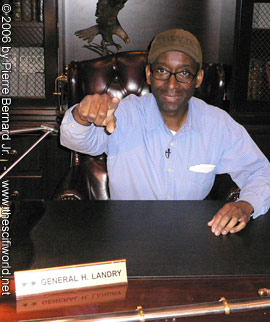
Before long, I found myself in a hand with helmet-man and a few other players. My stack was back up to about 800, while helmet-man had just bought in for another 500. I was in a blind with K7 and the flop was KQT. I bet and got a caller, and then helmet-man raised. I called and the third player, who I though may have had a J for a straight draw but also may have already had me beat, also just called on the flop. The turn was a 6. We both checked to the helmeted man, who bet again. I can't remember the exact amount but I think this bet was about $175. I called again and the other player folded. The river was a 2, and I put helmet-man all-in for his last $175. He called and showed K9 for the win.
I was at a "must-move" table and had to leave before getting into another hand with this crazy player, and he didn't stick around long enough to move into the main game where I had been moved. Even without him at the table, the game was quite beatable. After losing a bit more I was able to come back and even make several hundred before heading home.
Thursday, April 19, 2007
"Wilson's Law"
Just in case I don't become famous for my theoretical "River-Call Bluff," I've decided to name something else after myself. I call it "Wilson's Law," and it should apply not only to poker but also to any other endeavor involving any amount of chance. Before I describe it, let me explain what made me think of it.
I've been winning a lot recently, and I'm very aware that I've been quite lucky. However, I've also never heard of anyone actually overestimating his own luck (with the possible exception of Lou Gehrig) . A player who's losing usually seems to think that he's the only one at the table who has ever lost to a flush draw, and the player who caught the flush usually seems to think that he "deserved" to win that one because he can remember some previous instance where he missed a draw. I think everyone is subject to this mode of thinking, although obviously to varying degrees. With this in mind, it occurs to me that even though I readily acknowledge that I've been lucky recently, I'm probably still underestimating the extent. This line of reasoning reminded me of Hofstadter's Law: "It always takes longer than you expect, even when you take into account Hofstadter's Law." This led me to the formulation of what I will now dub "Wilson's Law": You're always luckier than you consider yourself to be, even when you take into account Wilson's Law.
I've been winning a lot recently, and I'm very aware that I've been quite lucky. However, I've also never heard of anyone actually overestimating his own luck (with the possible exception of Lou Gehrig) . A player who's losing usually seems to think that he's the only one at the table who has ever lost to a flush draw, and the player who caught the flush usually seems to think that he "deserved" to win that one because he can remember some previous instance where he missed a draw. I think everyone is subject to this mode of thinking, although obviously to varying degrees. With this in mind, it occurs to me that even though I readily acknowledge that I've been lucky recently, I'm probably still underestimating the extent. This line of reasoning reminded me of Hofstadter's Law: "It always takes longer than you expect, even when you take into account Hofstadter's Law." This led me to the formulation of what I will now dub "Wilson's Law": You're always luckier than you consider yourself to be, even when you take into account Wilson's Law.
Monday, April 16, 2007
The River-Call Bluff
Often, after being called on a river-bluff, a player will try to avoid having to show the hand he bluffed with. Technically, having been called on the river, the bluffer is required to show his hand first, but obviously he'd rather not have to show a hand he knows is going to lose anyway. If the caller doesn't immediately show his hand, the bluffer will often act like he is about to muck his hand and say something like "you win," trying to pressure the caller into showing his cards. Being rather non-confrontational, I've usually been inclined to acquiesce to this ploy and show my cards if I've called someone's bluff. I think I'm going to stop doing this. The main reason is that I'd really like to know what people are trying to bluff with, and by showing my cards first I forfeit my right to see what the bluffer had. I've occassionally told the bluffer to "show or muck," and although this tends to upset and offend the bluffer, it has the desired effect of forcing the bluffer to show before I do. Most of the time the bluffer will show his hand, but it's not uncommon for him to opt to just muck it. This result is especially desirable for me because, when my opponent mucks first, I don't need to show my hand either. This way my opponents won't figure out the types of hands I'm willing to call bluffs with.
Other times, a bluffer will immediately just show or muck his hand immediately after being called on a bluff without going through this ordeal. Personally, I usually just show my hand immediately.
After playing with particular players for long enough, I can often place them in one of these four categories based on how they react to having their bluff called: always show, always muck, reluctantly show, reluctantly muck.
This has led me to occasionally consider a play I've never heard of before. I think I may have just invented it. Hopefully, like Daisuke Matsuzaka and the gyroball, I will become legendary for using this play even though I never actually have tried it. I call it: "The River-Call Bluff". I'm pretty sure it can only work in live play (as opposed to online), and it can probably only be used profitably against players you know from experience bluff a lot and fall into either the "always muck" or "reluctantly muck" categories. It would also help if your opponent is aware of your tendency to resist pressure to show your hand first after calling a river-bluff; this way the bluffer won't suspect what you're trying.
This is how the River-Call Bluff works: Your opponent bets on the river, and you suspect it is a bluff. However, your hand is so weak that it very likely would lose even to a bluff (for instance, you were drawing to a 6-high straight and missed). Despite your hopeless hand, you call anyway. Your opponent mucks his hand, either immediately or after you refuse to show your hand first, and you take down the pot. And there you have it: The River-Call Bluff.
Has anyone ever seen this play even attempted?
Optional: show your 7-high hand that you just called with and send your opponent on tilt.
Other times, a bluffer will immediately just show or muck his hand immediately after being called on a bluff without going through this ordeal. Personally, I usually just show my hand immediately.
After playing with particular players for long enough, I can often place them in one of these four categories based on how they react to having their bluff called: always show, always muck, reluctantly show, reluctantly muck.
This has led me to occasionally consider a play I've never heard of before. I think I may have just invented it. Hopefully, like Daisuke Matsuzaka and the gyroball, I will become legendary for using this play even though I never actually have tried it. I call it: "The River-Call Bluff". I'm pretty sure it can only work in live play (as opposed to online), and it can probably only be used profitably against players you know from experience bluff a lot and fall into either the "always muck" or "reluctantly muck" categories. It would also help if your opponent is aware of your tendency to resist pressure to show your hand first after calling a river-bluff; this way the bluffer won't suspect what you're trying.
This is how the River-Call Bluff works: Your opponent bets on the river, and you suspect it is a bluff. However, your hand is so weak that it very likely would lose even to a bluff (for instance, you were drawing to a 6-high straight and missed). Despite your hopeless hand, you call anyway. Your opponent mucks his hand, either immediately or after you refuse to show your hand first, and you take down the pot. And there you have it: The River-Call Bluff.
Has anyone ever seen this play even attempted?
Optional: show your 7-high hand that you just called with and send your opponent on tilt.
Tuesday, April 10, 2007
Back From Las Vegas
I ventured back to Las Vegas last week for the first time since I moved to Los Angeles.I can't really explain why it took me so long, except that I've gotten very tired of travelling, and I didn't have any particular occasion to go. Last week, though, Joe was home, meaning I'd have a nice house to stay in instead of paying for a hotel or sleeping on someone's couch. Also, this meant I'd have someone to play with most of the time.
Being back in Las Vegas made me realize that there is still such a thing as a mediocre player willing to play above the smallest limits at a casino. Such a person has become very rare in Los Angeles. Also, I was not just imagining that the LA casino's have a much more dour atmosphere. Frankly, I was shocked to realize how much fun it was to play poker again. I think the main difference is the fact that players in Las Vegas are mostly there on vacation. They're excited to be there, and the excitement permeates the room in the same way that despair seems to preside over places like the Commerce and Hollywood Park. Okay, I'm exaggerating, but the contrast was really quite remarkable. Until last week, I had convinced myself that I had judged the LA casinos too harshly when I first moved out here, and that they are actually almost as good as the ones in Las Vegas. They aren't.
One positive development is that I was able to profitably play in the 5-10 and even briefly 10-20 NL games in Las Vegas. Having become accustomed to these stakes I think I will be more comfortable playing in games bigger than the $400 buyin 5-10 NL at Hollywood Park.
Being back in Las Vegas made me realize that there is still such a thing as a mediocre player willing to play above the smallest limits at a casino. Such a person has become very rare in Los Angeles. Also, I was not just imagining that the LA casino's have a much more dour atmosphere. Frankly, I was shocked to realize how much fun it was to play poker again. I think the main difference is the fact that players in Las Vegas are mostly there on vacation. They're excited to be there, and the excitement permeates the room in the same way that despair seems to preside over places like the Commerce and Hollywood Park. Okay, I'm exaggerating, but the contrast was really quite remarkable. Until last week, I had convinced myself that I had judged the LA casinos too harshly when I first moved out here, and that they are actually almost as good as the ones in Las Vegas. They aren't.
One positive development is that I was able to profitably play in the 5-10 and even briefly 10-20 NL games in Las Vegas. Having become accustomed to these stakes I think I will be more comfortable playing in games bigger than the $400 buyin 5-10 NL at Hollywood Park.
Tuesday, March 27, 2007
$400 NL at Hollywood Park
In Las Vegas, nobody ever bought into a 5-10 NL game for less than $500, and rarely less than $1000. At Hollywood Park and the Commerce here in LA, most of the 5-10 NL games have a mandatory $400 buy-in. Sometimes Hollywood Park has a "$500 NL" game as well. This also uses 5-10 blinds, but the $500 is only a minimum buy-in. There is no maximum. This format is very similar to the 5-10NL game at the Wynn or Bellagio.
I played mostly 2-5 NL in Vegas and 3-5 NL here in LA. The thing is, the game is a lot smaller in LA because the buyin is fixed at $200. The Bellagio was the same way when I first moved the Vegas, but after I few months I was playing mostly in 2-5 NL games that allowed players to buy in for $500 or more. Thus the 2-5 games in Las Vegas are quite a bit bigger than the 3-5 games in LA.
However, I've found that the 5-10, $400 NL games here play quite a bit bigger than the $2-5, $500 games in Vegas. The double-sized blinds really drive the action. With preflop raised of $35-$45 rather than $20, players run through their $400 stacks rather quickly, and what ends up happening is that while a few players still have $400 stacks, most of the table is up over $1000. (This necessitates constant awareness of my opponents' stack sizes. Hands need to be played differently against a $400 stack from against a $1000, and another way if I'm playing against one of each.) As some players gain larger stacks and the other players fade away or keep contributing, the game becomes quite large.
For whatever reason, I've been crushing this game in the past couple of weeks. Although there are still a few fish, the players in this game are generally quite good. Certainly, my success so far certainly has a lot to do with luck in a small sample of hands, but I also feel that I have a stronger grasp on how to deal with various stack sizes than do most of my opponents. With a short stack, speculative hands lose much of their value, since you can't keep getting paid off on the turn and river if you flop a big hand. This seems obvious, but even the good players in this 5-10 game try to get creative with $400 stacks as if they had $1500. This just doesn't work. No matter how hard you try, you can't make J8s win enough money if you have to pay $40 to see the flop and you only have $400. The same goes if you have $2000 but most of your opponents have only $400.
One particularly profitable day included the following hand. This is one of three or four hands where I called an all-in bet due to pot odds, despite not knowing if I had a better than 50% shot at winning, and I won all but one of these hands. When I win 6 large pots when I would normally only win 3, it makes for a big day.
On one particular hand I was three off the button, and there were two limpers in front of me. I looked down at 2h2c and limped for $10. I had everyone covered, with most players around $1000. A loose player to my left limped, and the button, a somewhat new player who had shown considerable skill in one previous hand, raised to $25. A raise this small is very unusual and can only really hope to knock out the two blinds. Nobody is going to fold a hand they limped with. Sklansky and Miller recommend doing this occassionally with speculative hands like Axs in order to "sweeten the pot." This is a strategy I'm quite skeptical of, but it could be what the raiser had in mind here. I also see it a lot with AA because the raiser doesn't want to lose anybody from the pot (another mistake in my view - much better to get as much money in as possible while you are still sure you hold the best hand. Somebody will almost always call a raise to $60 here, probably even $125). The only time I ever make such a small raise pre-flop is when I'm first in and there is a player who likes to raise a lot preflop but won't reraise without a big hand. Raising to $25 with A9s here allows me to see the flop rather than having to face a likely raise to $45. This idea clearly doesn't apply to the button raiser in this hand. I had no clear idea of what he had except that he clearly was not bluffing. I thought his most likely hands were non-face pairs (2-10 or AA). Maybe a suited ace.
Everyone but the small blind called the raise to $25. Minus the $5 rake the pot was $125.
Flop: 2d 7c 9c. Checks around to me. I checked as well, planning to check-raise after drawing a few people in. If there was no bet behind me I may have to fold my hand if one of the many draws hit the board, but I thought the risk was worth it. The next player checked and the button bet $50, another oddly small bet. The next two players folded, so I just called. The two folds made raising less important because I didn't need to worry so much about drawing hands, and just calling might draw in another $50 from the player to my right. He folded. Pot: $225. My opponent has $1025 left.
Turn: Ah. I bet $200. No point in fooling around anymore. If he's afraid of the ace I won't get any more money out of him no matter what I do. Betting is the most efficient way to get the money in. My opponent pushes all-in for another $825. Our two $200 bets plus the $225 pot means my pot odds here are $(825+625) to $825, or about 1.8 to 1. I thought he must have 77, 99, or AA. The only other hand I could imagine were nut club draws or club draws with an inside straight draw. These hands have a lot of outs against me. I have but one out against I higher set. There's also the possibility of A9s or A7s but I didn't think these hands were likely to begin with, and the board blocks half the suited possibilities. (He can only have these 2-pair hands if they're suited in diamonds or spades now.) And of course there's the possibility that he has something much worse that I didn't think of. I considered folding here. My image at the table had to be as a strong player willing to gamble. My opponent seemed good enough to have noticed this, so it's unlikely he is expecting me to fold. The higher sets seemed extremely likely, and the draws had many outs against me. Even the two-pair hands have 4 outs. Despite this, I eventually decided I probably had a good enough chance to justify the call. Although I thought I was very likely beaten, 1.75 to 1 odds is a lot better than 1 to 1. I called, thinking I had about a 45-50% chance to win. My opponent had Ad9d, and he missed his 4 outs on the river.
The other players were astonished that it took me more than a few seconds to make the call. Some of them even told me they lost respect for me just because I had to think about it. One of them was even shouting at me. In retrospect I think they were all a bit frustrated that I had won yet another big pot. Only two other players agreed it was a tough call (one of them was the guy who had just lost his stack to me). It's interesting when other players give their opinions on strategy, but it's pretty rare to have almost everyone at the table offer up their thoughts unsolicited. I can't really think of another example that produced quite so much heated discussion among players who were not even involved in the hand.
I played mostly 2-5 NL in Vegas and 3-5 NL here in LA. The thing is, the game is a lot smaller in LA because the buyin is fixed at $200. The Bellagio was the same way when I first moved the Vegas, but after I few months I was playing mostly in 2-5 NL games that allowed players to buy in for $500 or more. Thus the 2-5 games in Las Vegas are quite a bit bigger than the 3-5 games in LA.
However, I've found that the 5-10, $400 NL games here play quite a bit bigger than the $2-5, $500 games in Vegas. The double-sized blinds really drive the action. With preflop raised of $35-$45 rather than $20, players run through their $400 stacks rather quickly, and what ends up happening is that while a few players still have $400 stacks, most of the table is up over $1000. (This necessitates constant awareness of my opponents' stack sizes. Hands need to be played differently against a $400 stack from against a $1000, and another way if I'm playing against one of each.) As some players gain larger stacks and the other players fade away or keep contributing, the game becomes quite large.
For whatever reason, I've been crushing this game in the past couple of weeks. Although there are still a few fish, the players in this game are generally quite good. Certainly, my success so far certainly has a lot to do with luck in a small sample of hands, but I also feel that I have a stronger grasp on how to deal with various stack sizes than do most of my opponents. With a short stack, speculative hands lose much of their value, since you can't keep getting paid off on the turn and river if you flop a big hand. This seems obvious, but even the good players in this 5-10 game try to get creative with $400 stacks as if they had $1500. This just doesn't work. No matter how hard you try, you can't make J8s win enough money if you have to pay $40 to see the flop and you only have $400. The same goes if you have $2000 but most of your opponents have only $400.
One particularly profitable day included the following hand. This is one of three or four hands where I called an all-in bet due to pot odds, despite not knowing if I had a better than 50% shot at winning, and I won all but one of these hands. When I win 6 large pots when I would normally only win 3, it makes for a big day.
On one particular hand I was three off the button, and there were two limpers in front of me. I looked down at 2h2c and limped for $10. I had everyone covered, with most players around $1000. A loose player to my left limped, and the button, a somewhat new player who had shown considerable skill in one previous hand, raised to $25. A raise this small is very unusual and can only really hope to knock out the two blinds. Nobody is going to fold a hand they limped with. Sklansky and Miller recommend doing this occassionally with speculative hands like Axs in order to "sweeten the pot." This is a strategy I'm quite skeptical of, but it could be what the raiser had in mind here. I also see it a lot with AA because the raiser doesn't want to lose anybody from the pot (another mistake in my view - much better to get as much money in as possible while you are still sure you hold the best hand. Somebody will almost always call a raise to $60 here, probably even $125). The only time I ever make such a small raise pre-flop is when I'm first in and there is a player who likes to raise a lot preflop but won't reraise without a big hand. Raising to $25 with A9s here allows me to see the flop rather than having to face a likely raise to $45. This idea clearly doesn't apply to the button raiser in this hand. I had no clear idea of what he had except that he clearly was not bluffing. I thought his most likely hands were non-face pairs (2-10 or AA). Maybe a suited ace.
Everyone but the small blind called the raise to $25. Minus the $5 rake the pot was $125.
Flop: 2d 7c 9c. Checks around to me. I checked as well, planning to check-raise after drawing a few people in. If there was no bet behind me I may have to fold my hand if one of the many draws hit the board, but I thought the risk was worth it. The next player checked and the button bet $50, another oddly small bet. The next two players folded, so I just called. The two folds made raising less important because I didn't need to worry so much about drawing hands, and just calling might draw in another $50 from the player to my right. He folded. Pot: $225. My opponent has $1025 left.
Turn: Ah. I bet $200. No point in fooling around anymore. If he's afraid of the ace I won't get any more money out of him no matter what I do. Betting is the most efficient way to get the money in. My opponent pushes all-in for another $825. Our two $200 bets plus the $225 pot means my pot odds here are $(825+625) to $825, or about 1.8 to 1. I thought he must have 77, 99, or AA. The only other hand I could imagine were nut club draws or club draws with an inside straight draw. These hands have a lot of outs against me. I have but one out against I higher set. There's also the possibility of A9s or A7s but I didn't think these hands were likely to begin with, and the board blocks half the suited possibilities. (He can only have these 2-pair hands if they're suited in diamonds or spades now.) And of course there's the possibility that he has something much worse that I didn't think of. I considered folding here. My image at the table had to be as a strong player willing to gamble. My opponent seemed good enough to have noticed this, so it's unlikely he is expecting me to fold. The higher sets seemed extremely likely, and the draws had many outs against me. Even the two-pair hands have 4 outs. Despite this, I eventually decided I probably had a good enough chance to justify the call. Although I thought I was very likely beaten, 1.75 to 1 odds is a lot better than 1 to 1. I called, thinking I had about a 45-50% chance to win. My opponent had Ad9d, and he missed his 4 outs on the river.
The other players were astonished that it took me more than a few seconds to make the call. Some of them even told me they lost respect for me just because I had to think about it. One of them was even shouting at me. In retrospect I think they were all a bit frustrated that I had won yet another big pot. Only two other players agreed it was a tough call (one of them was the guy who had just lost his stack to me). It's interesting when other players give their opinions on strategy, but it's pretty rare to have almost everyone at the table offer up their thoughts unsolicited. I can't really think of another example that produced quite so much heated discussion among players who were not even involved in the hand.
Tuesday, March 20, 2007
Strangeness at Hollywood Park
Every hour or so at Hollywood Park, an employee goes around to each table and scans the "Players Cards" for comp points. As a cue for players to get their cards ready, the scanner will usually announce "player's card!" as they approach. In a ridiculous amalgamation of Asian and Mexican accents, one day one of the Asian card-scanners exuberantly rolled the "L" in "Players Card" as he approached each table, which should not even be conceivable unless you are accustomed to pronouncing L's like R's.
There's another guy I have seen several times standing and chatting with people in the poker room while wearing a chrome bowl on his head as a helmet, complete with straps under his chin. The man himself looks somewhat like Flavor Flav. I hesitate to comment on this due to the possibility he wears it for some medical purpose, but either way, it is ridiculous-looking. I laugh inside every time I see him.
There's another guy I have seen several times standing and chatting with people in the poker room while wearing a chrome bowl on his head as a helmet, complete with straps under his chin. The man himself looks somewhat like Flavor Flav. I hesitate to comment on this due to the possibility he wears it for some medical purpose, but either way, it is ridiculous-looking. I laugh inside every time I see him.
Monday, March 12, 2007
Updates
I thought this week I'd update some things I'd written about in previous posts.
Last week I wrote about applying for a job with the A's. Haven't heard back from them yet.
I'm happy with my decision to play mostly at Hollywood Park. I've been playing during the day, during the five hour period from 2:30 to 7:30 when the traffic is at its worst. While most of the drawbacks to Hollywood Park still hold, I was wrong about a couple of things. Some of the tables do have automatic shufflers, which I like. The bathrooms are much cleaner than at the Commerce. There's actually an easy way to avoid walking up the hill to get inside, and it's never smelled of horses there after that one time. Also, some how I only just realized that there is another whole section of tournament tables. I had thought the other side of the casino was all table games, but half of that side is for poker as well. Supposedly there are tournaments every day around 11:30am ($30 w/ rebuys yesterday) and 7pm ($300 with one rebuy yesterday). Those aren't ideal times for me, but I'll probably find my way into one or two in the next month. I haven't played in a single tournament since moving here (unless you count private games).
I've also heard good things about the customer service at the Bike and the Hustler casinos. The Bike is just past the Commerce, and the Hustler is just past Hollywood Park, so I've always stopped at the closer casinos and never made it to either the Bike or the Hustler. Well I was actually at the Bike once or twice.
Another interesting thing at Hollywood Park is that next to the cashier they have small signs posted warning about low-quality counterfeit $100 bills. This is pretty much all I expected from the Wynn. Instead I got treated like a criminal for trying to let them know that they should be on the lookout for counterfeits.
Before heading out to play each day I've been reading a section of No Limit Holdem: Theory and Practice. I like this approach because it gives me time to absorb each section while actually playing for several hours. Most of the material is not new to me. Some of it is, though, and the rest is worthwhile as reinforcement of some fundamentals. Also, unlike Harrington on Holdem, Sklansky and Miller include footnotes explaining themselves whenever they feel the need to simplify strategic discussions. I'm only half way through but I'd say the book is worthwhile. I'm looking forward to the second section of the book, "Concepts and Weapons."
Last week I wrote about applying for a job with the A's. Haven't heard back from them yet.
I'm happy with my decision to play mostly at Hollywood Park. I've been playing during the day, during the five hour period from 2:30 to 7:30 when the traffic is at its worst. While most of the drawbacks to Hollywood Park still hold, I was wrong about a couple of things. Some of the tables do have automatic shufflers, which I like. The bathrooms are much cleaner than at the Commerce. There's actually an easy way to avoid walking up the hill to get inside, and it's never smelled of horses there after that one time. Also, some how I only just realized that there is another whole section of tournament tables. I had thought the other side of the casino was all table games, but half of that side is for poker as well. Supposedly there are tournaments every day around 11:30am ($30 w/ rebuys yesterday) and 7pm ($300 with one rebuy yesterday). Those aren't ideal times for me, but I'll probably find my way into one or two in the next month. I haven't played in a single tournament since moving here (unless you count private games).
I've also heard good things about the customer service at the Bike and the Hustler casinos. The Bike is just past the Commerce, and the Hustler is just past Hollywood Park, so I've always stopped at the closer casinos and never made it to either the Bike or the Hustler. Well I was actually at the Bike once or twice.
Another interesting thing at Hollywood Park is that next to the cashier they have small signs posted warning about low-quality counterfeit $100 bills. This is pretty much all I expected from the Wynn. Instead I got treated like a criminal for trying to let them know that they should be on the lookout for counterfeits.
Before heading out to play each day I've been reading a section of No Limit Holdem: Theory and Practice. I like this approach because it gives me time to absorb each section while actually playing for several hours. Most of the material is not new to me. Some of it is, though, and the rest is worthwhile as reinforcement of some fundamentals. Also, unlike Harrington on Holdem, Sklansky and Miller include footnotes explaining themselves whenever they feel the need to simplify strategic discussions. I'm only half way through but I'd say the book is worthwhile. I'm looking forward to the second section of the book, "Concepts and Weapons."
Sunday, March 04, 2007
Job?
For the first time since quitting my old job to play poker, I've applied for a new one. This decision was based much more on the attractiveness of the particular job than a desire to quit poker. The job in question is almost precisely what I was looking for when I graduated college: statistical analysis for the baseball operations department on a major league team. A friend alerted me to a posting on the Oakland A's website about an opening for the position of "Baseball Operations Intern." It looks like mostly number crunching and programming, but I actually kind of like doing that. Also, as I learned three years ago, it's incredibly difficult to get your foot in the door of the baseball industry, so even a somewhat attractive position would be worthwhile. This baseball operations position is much more attractive than any that I saw posted three years ago when I was looking for such jobs. The fact that it's with the A's is a plus, since it's at least in the state where I currently live, and the A's are known as the pioneers of objective statistical analysis in baseball operations. Also, there are some poker casinos in the area, but I would likely take a hiatus from poker if I got the job.
Applying for this position also gave me occasion to update my resume. Here's what I had to say about my past two years:
Applying for this position also gave me occasion to update my resume. Here's what I had to say about my past two years:
Professional Poker Player.
Played tournaments and cash games in various casinos. Requires consistent, efficient, and accurate application of analytical skills encompassing the fields of psychology, game theory, statistics, mathematics, and economics. Particularly important is an understanding of risk management, rational decision-making, and statistical inference. Independently researched these topics and retrospectively analyzed my play in order to improve playing ability and expected winning rates. (2005-present)
Monday, February 26, 2007
Perception of Money
Last night I was playing 3-5 NL at Hollywood Park. There were a couple of slightly fishy types, but most of my opponents were regulars, including two very tight, aggressive, uncreative players. Both of these guys are very regular at Hollywood Park - I've seen them a few times before and they know all the dealers and floor people. One of the two regulars was sitting directly to my left. He was about 60 and had been folding consistently while watching and commenting on the Lakers game. Finally, he got a hand he liked. Raising preflop, he proceeded to call down another player on a rather raggety board. The other player was loosish and passive, rarely bluffing, if ever. On this hand the loose/passive player bet strongly on the flop, turn, and river. At the end he showed a set of three's. As the old regular was counting out his last bet, I think someone asked him what he had.
"Oh, nothing," he said in a frustrated, sarcastic sort of way. "Just a pair of kings. That's all. Nothing good. It's not like I had a good hand or anything." The old guy kept grumbling about it for a few minutes. Eventually, the winning player said "sorry about that" and the regular said "it's not your fault, it's just frustrating."
I'm telling this story now because it reminded me of something I wanted to write about: how automatic it has become for me to separate the money used in poker with the money I use to purchase things. Of course, it's all just money, and what can be used for one can just as easily be used for the other. However, for some reason it is perfectly natural for me to make a semi-bluff of several hundred dollars but I consider a purchase of several hundred dollar to be very significant. I'm not sure if this mental dichotomy is rational, but it does allow my otherwise tight-fisted psyche to play poker without having my judgment clouded by financial concerns. When I lose a big pot, say $1000, it barely even occurs to me that I had been playing for money. My thought is "darn, I lost," and I will often go over the hand again in my head to see if I could have played the hand any better. Contrast this with a scenario where I had just bought a computer for $2000 that I then realized I could have had for $1000. In this case I'd be immediately and acutely aware of my financial "loss," and I'd be very upset. The reason the story about the old regular reminded me of this is that I was taken aback by his apparent lack of this mental dichotomy. I see this a lot among regulars, and it never fails to amaze me. I just can't understand how they manage to stay focused on poker strategy when they are so distracted by financial concerns. My suspicion is that these players tend to be very tight, somewhat aggressive, straightforward players, as this regular was. That approach is consistent with a risk-averse, mechanical mentality that I think is characteristic of how most people behave in regards to their personal finances. They figure "if I play the best cards, I should win against worse cards, and there's not much chance for me to lose." Naturally, then, such player get upset when they do lose. At least, that's the best I can do to try to explain it. Like I said, I'm still taken aback by regular players who can't deal with swings of a few hundred dollars.
This mental dichotomy I seem to have has some potential downsides. For one thing, I don't think most of the great players have it. They tend to be gamblers who crave action. Otherwise they would never have moved up in limits quickly enough to be where they're at now. More practically, the dichotomy can cause unusual decisions when I have to pay for something with my chips, be it an implicit purchase or explicit. An example of an implicit purchase would be "paying to see." Is it worth a $100 call to see this guys hand? The answer is almost certainly "no," but when I am paying with "just chips" the prospect doesn't seem quite so ridiculous. More explicit is paying the dealer for dealing, in the form of tips. Because I'm paying in chips, it often doesn't seem so expensive to give the dealer $5. I just give the dealer $1 for every hand I win unless the pot is very small (eg just the blinds). That way I don't even have to think about it.
On a few occasions I have sold the right to see my hand after the hand was over. The most I have ever gotten for this is $35. That's right, somebody paid me $35 just to turn my cards over after they folded at the end of a hand. When sitting behind $1000 in chips this doesn't seem so much, but $35 in chips is 35 real dollars that I can buy things with. It's not considered good form to be so serious about money at the table, so I try to let my mental dichotomy manifest itself in my table demeanor. For instance, I almost never pout over a loss or celebrate a win. When it comes to making actual financial decisions, though, I try to make myself consider the actual value in terms of real money. I'm not going to turn down $35 just to hide my cards. Oftentimes I even think showing my cards actually helps my table image.
"Oh, nothing," he said in a frustrated, sarcastic sort of way. "Just a pair of kings. That's all. Nothing good. It's not like I had a good hand or anything." The old guy kept grumbling about it for a few minutes. Eventually, the winning player said "sorry about that" and the regular said "it's not your fault, it's just frustrating."
I'm telling this story now because it reminded me of something I wanted to write about: how automatic it has become for me to separate the money used in poker with the money I use to purchase things. Of course, it's all just money, and what can be used for one can just as easily be used for the other. However, for some reason it is perfectly natural for me to make a semi-bluff of several hundred dollars but I consider a purchase of several hundred dollar to be very significant. I'm not sure if this mental dichotomy is rational, but it does allow my otherwise tight-fisted psyche to play poker without having my judgment clouded by financial concerns. When I lose a big pot, say $1000, it barely even occurs to me that I had been playing for money. My thought is "darn, I lost," and I will often go over the hand again in my head to see if I could have played the hand any better. Contrast this with a scenario where I had just bought a computer for $2000 that I then realized I could have had for $1000. In this case I'd be immediately and acutely aware of my financial "loss," and I'd be very upset. The reason the story about the old regular reminded me of this is that I was taken aback by his apparent lack of this mental dichotomy. I see this a lot among regulars, and it never fails to amaze me. I just can't understand how they manage to stay focused on poker strategy when they are so distracted by financial concerns. My suspicion is that these players tend to be very tight, somewhat aggressive, straightforward players, as this regular was. That approach is consistent with a risk-averse, mechanical mentality that I think is characteristic of how most people behave in regards to their personal finances. They figure "if I play the best cards, I should win against worse cards, and there's not much chance for me to lose." Naturally, then, such player get upset when they do lose. At least, that's the best I can do to try to explain it. Like I said, I'm still taken aback by regular players who can't deal with swings of a few hundred dollars.
This mental dichotomy I seem to have has some potential downsides. For one thing, I don't think most of the great players have it. They tend to be gamblers who crave action. Otherwise they would never have moved up in limits quickly enough to be where they're at now. More practically, the dichotomy can cause unusual decisions when I have to pay for something with my chips, be it an implicit purchase or explicit. An example of an implicit purchase would be "paying to see." Is it worth a $100 call to see this guys hand? The answer is almost certainly "no," but when I am paying with "just chips" the prospect doesn't seem quite so ridiculous. More explicit is paying the dealer for dealing, in the form of tips. Because I'm paying in chips, it often doesn't seem so expensive to give the dealer $5. I just give the dealer $1 for every hand I win unless the pot is very small (eg just the blinds). That way I don't even have to think about it.
On a few occasions I have sold the right to see my hand after the hand was over. The most I have ever gotten for this is $35. That's right, somebody paid me $35 just to turn my cards over after they folded at the end of a hand. When sitting behind $1000 in chips this doesn't seem so much, but $35 in chips is 35 real dollars that I can buy things with. It's not considered good form to be so serious about money at the table, so I try to let my mental dichotomy manifest itself in my table demeanor. For instance, I almost never pout over a loss or celebrate a win. When it comes to making actual financial decisions, though, I try to make myself consider the actual value in terms of real money. I'm not going to turn down $35 just to hide my cards. Oftentimes I even think showing my cards actually helps my table image.
Wednesday, February 21, 2007
Dean Zes
On Saturday I had an interesting conversation with Dave Zes, one of Brigid's classmates in the UCLA statistics department. We were having lunch after a hike and he asked me what department I was in.
"Oh, I'm not a student, I'm just here with Brigid."
"Oh, ok. So, what do you do?"
"Actually, I'm supporting myself by playing poker."
I've had this type of conversation dozens of times, with a wide range of responses. This was one of the more interesting ones.
"Oh, that's cool. My dad is a mathematician and knows a lot of those old time poker players," Dave told me. "Do you know of Chip Reese, Doyle Brunson? Those guys are like family friends. They have some really interesting stories." He went on to tell me that his dad had written some books on gaming and had contributed to some poker books. When I googled him just now it showed mostly just showed some technical math papers he had written. I didn't find much involving poker, but one thing I found is that he is mentioned in Doyle Brunson's original Super System, in the section on Lowball. The "expert" author of that section, Joey Hawthorne, says on page 185, "my draw expert, 'Crazy Mike' put me in touch with noted mathematician Dean Zes, who has probably done more work on the minimum standards of Ace-to-Five than anyone else." Despite the pedigree, Dave says he doesn't have the patience to play poker well himself.
This marks the second interesting poker-related connection involving UCLA statistics grad students. I guess it's pretty unlikely for anything to come of them, but it's cool nonetheless.
"Oh, I'm not a student, I'm just here with Brigid."
"Oh, ok. So, what do you do?"
"Actually, I'm supporting myself by playing poker."
I've had this type of conversation dozens of times, with a wide range of responses. This was one of the more interesting ones.
"Oh, that's cool. My dad is a mathematician and knows a lot of those old time poker players," Dave told me. "Do you know of Chip Reese, Doyle Brunson? Those guys are like family friends. They have some really interesting stories." He went on to tell me that his dad had written some books on gaming and had contributed to some poker books. When I googled him just now it showed mostly just showed some technical math papers he had written. I didn't find much involving poker, but one thing I found is that he is mentioned in Doyle Brunson's original Super System, in the section on Lowball. The "expert" author of that section, Joey Hawthorne, says on page 185, "my draw expert, 'Crazy Mike' put me in touch with noted mathematician Dean Zes, who has probably done more work on the minimum standards of Ace-to-Five than anyone else." Despite the pedigree, Dave says he doesn't have the patience to play poker well himself.
This marks the second interesting poker-related connection involving UCLA statistics grad students. I guess it's pretty unlikely for anything to come of them, but it's cool nonetheless.
Subscribe to:
Posts (Atom)